

Mr. Murray, a 1961 Purdue chemical engineering alumnus, has demonstrated a longstanding commitment to CISTAR’s mission by generously supporting the Center and establishing this fellowship to assist its graduate student researchers. With this award, Diamarys joins a distinguished community of CISTAR Graduate Fellows who have been honored with this recognition over the years.
CISTAR Graduate Fellow Student Spotlight: Diamarys Salome Rivera, 2025 CISTAR Bill Murray Fellowship Recipient
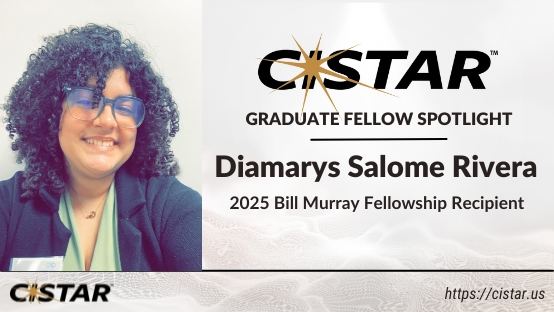
CISTAR congratulates Diamarys Salome Rivera, CISTAR graduate fellow at Purdue University, as she has been selected for the CISTAR Bill Murray Fellowship for the 2025-2026 academic year. The fellowship is funded by Purdue Chemical Engineering alum Mr. Murray (class of 1961). CISTAR faculty members nominate CISTAR graduate fellows based on their academic performance and research accomplishments.
“I am grateful and honored to be selected for this fellowship. I appreciate the support for my research that contributes to developing novel olefin oligomerization technologies using synthesis-structure-function relationships that guide the design of catalysts for sustainable energy and chemical production,” Diamarys said about being selected for the award.
Diamarys obtained her bachelor’s degree in chemical engineering from the University of Puerto Rico at Mayagüez (UPRM). Her strong interest in catalysis research began at UPRM in Dr. Pagán-Torres’ group, where she helped develop heterogeneous catalytic materials to convert biomass-derived resources and carbon dioxide into fuels and chemicals. Motivated to further develop her research, technical, and communication skills in catalysis, Diamarys chose to pursue a graduate degree at Purdue, viewing these skills as essential tools for her professional career. She now works in Dr. Rajamani Gounder’s research group as part of CISTAR’s Thrust 2, focusing on assessing the influence of Bronsted acid site location in MFI zeolites on propene oligomerization rates and selectivity.
Graduate fellow Spotlight Q&A:
What drew you to your specific research area and project?
“I liked CISTAR’s mission about developing new technologies to convert shale gas resources into transportation fuel products and chemicals economically, and by trying to reduce carbon emissions. I liked the idea of using these technologies as a bridge until we can develop renewable resources that can support our needs. That is why I showed interest in my research project that uses a solid acid catalyst that can be engineered with different properties for olefin oligomerization technologies.”
As a CISTAR fellow, how has CISTAR influenced your academic and professional growth?
“CISTAR has served as a platform to collaborate with a wide network of industry partners, other researchers across different universities, and advisors. The thrust and biannual meetings, as well as outreach activities, helped me a lot in improving my professional skills as well as moving forward with my research project.”
What skills or lessons from your time at CISTAR do you think will be most valuable in your future career?
“I think one of the most important skills is how to effectively communicate research ideas to a variety of researchers and industry partners of different backgrounds, so effective feedback can be provided as well as pushing your project to achieve commercial needs.”
What advice would you give to new graduate students entering CISTAR?
“To speak to your peers and other researchers, since this will grant multiple angles and ideas that will push your project forward. Often, the scope of work from research areas outside your own can be adapted, resulting in significant progress.”
How do you see your research impacting your field or the broader community?
“Implementing synthetic methods and kinetic probes for olefin oligomerization in zeolites will provide a route for optimal catalyst design in upscaling shale gas resources for fuel technologies.”
What hobbies or activities do you enjoy outside of your research?
“I love salsa dancing and playing sports like volleyball and basketball.”