
The Center for Innovative and Strategic Transformation of Alkane Resources, CISTAR, is one of the flagship Engineering Research Centers (ERCs) funded by the National Science Foundation. ERCs bring together industry, academia, and government to cultivate engineering discovery and education in research areas critical to our nation’s strength. CISTAR's four pillars —research, innovation ecosystem, engineering workforce development, and access and societal impact —are designed to enable CISTAR to achieve these goals. Engagement and implementation of each pillar are vital to CISTAR’s success as an ERC.
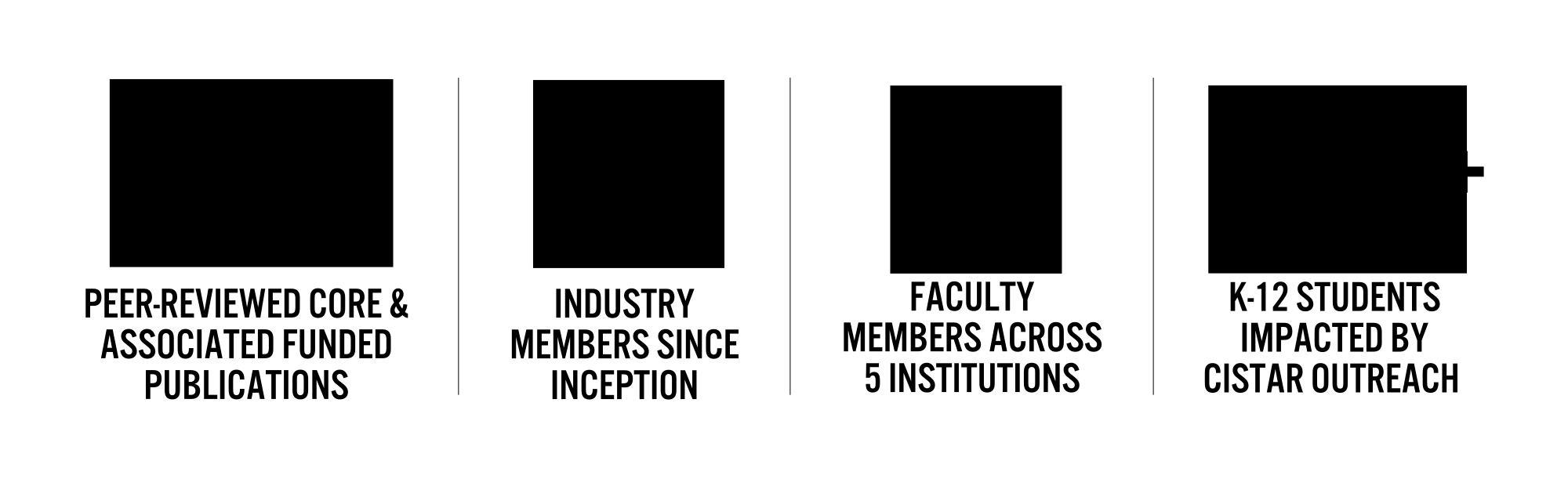
National Science Foundation Engineering Research Center program - Four Pillars Driving Impact
CISTAR operates as an NSF Engineering Research Center (ERC). ERCs make a significant impact on society by fostering strong collaborations between academia and industry, driving interdisciplinary research, and developing a highly skilled workforce. By aligning research with real-world needs, ERCs accelerate the transfer of innovative technologies to the marketplace and enhance corporate competitiveness. Their shared research facilities and cross-disciplinary teams enable the development of solutions to complex challenges in areas such as sustainable energy, healthcare, and advanced manufacturing. ERCs are also committed to workforce development, offering team-based education and outreach programs that prepare graduates to lead in industry. Through knowledge dissemination, policy alignment, and the creation of sustainable innovation ecosystems, ERCs ensure that their work continues to benefit society long after initial funding ends. Ultimately, ERCs play a vital role in translating research into tangible societal and economic benefits while raising public awareness of engineering’s essential contributions to improving quality of life.
ResearchWe advance the science and engineering of catalytic, separation, and process technologies, enabling small, modular, and networked plants that efficiently convert natural gas liquids into valuable products. Our research is guided by techno-economic and life-cycle analysis to ensure real-world impact. |
Access and Societal ImpactCISTAR is committed to building a collaborative environment where effective learners and researchers thrive. Our outreach and education initiatives promote STEM pathways that are accessible and enhance public understanding of responsible energy use. |
Innovation EcosystemWe bridge academia and industry, accelerating technology transfer and commercialization. Our robust industrial partnership program provides members with privileged access to intellectual property, research insights, and a pipeline of talented graduates. |
Our Partners
CISTAR’s collaborative model is built on the unique strengths and expertise of its five partner universities - Purdue University, the University of New Mexico, Northwestern University, the University of Notre Dame, and the University of Texas at Austin. Each institution brings specialized capabilities in research, education, and innovation that collectively drive CISTAR’s mission.
All research projects are designed to include principal investigators and fellows from multiple partner universities, ensuring that each project leverages the combined expertise in catalysis, separations, process engineering, modeling, and systems analysis.

Significant research Achievements
Breakthroughs in Catalyst & Membrane Technologies
To date, our team has developed an advanced understanding of solutions for coke formation and mitigation on platinum surfaces, achieving ethylene yields of up to 79% with near-complete carbon balance, and membrane systems with the capability to surpass industry benchmarks for high-temperature separations.
Techno-Economic Impacts and Innovation
Our team has demonstrated an internal rate of return of 20-26% for small-scale CISTAR processes converting natural gas liquids to liquid fuels, based on detailed process and economic modeling. Our efforts to identify the most promising technology leads (TRL 3/4) has led to several collaborations with Industry members: (i) Light Olefin Production through Methane Diluted Cracking, (ii) Highly Selective H2- and C2H2-Tolerant Olefin-Paraffin Separation Membranes, (iii) Mo-Zeolite Catalysts for Methane Dehydroaromatization.
These various collaborations have generated more than $8M in additional funding for translational research jointly with industry members. CISTAR is striving to continue this legacy of strong partnerships with industry in combination with national labs, delivering a generalized path toward sustaining the nation’s energy and carbon utilization infrastructure.